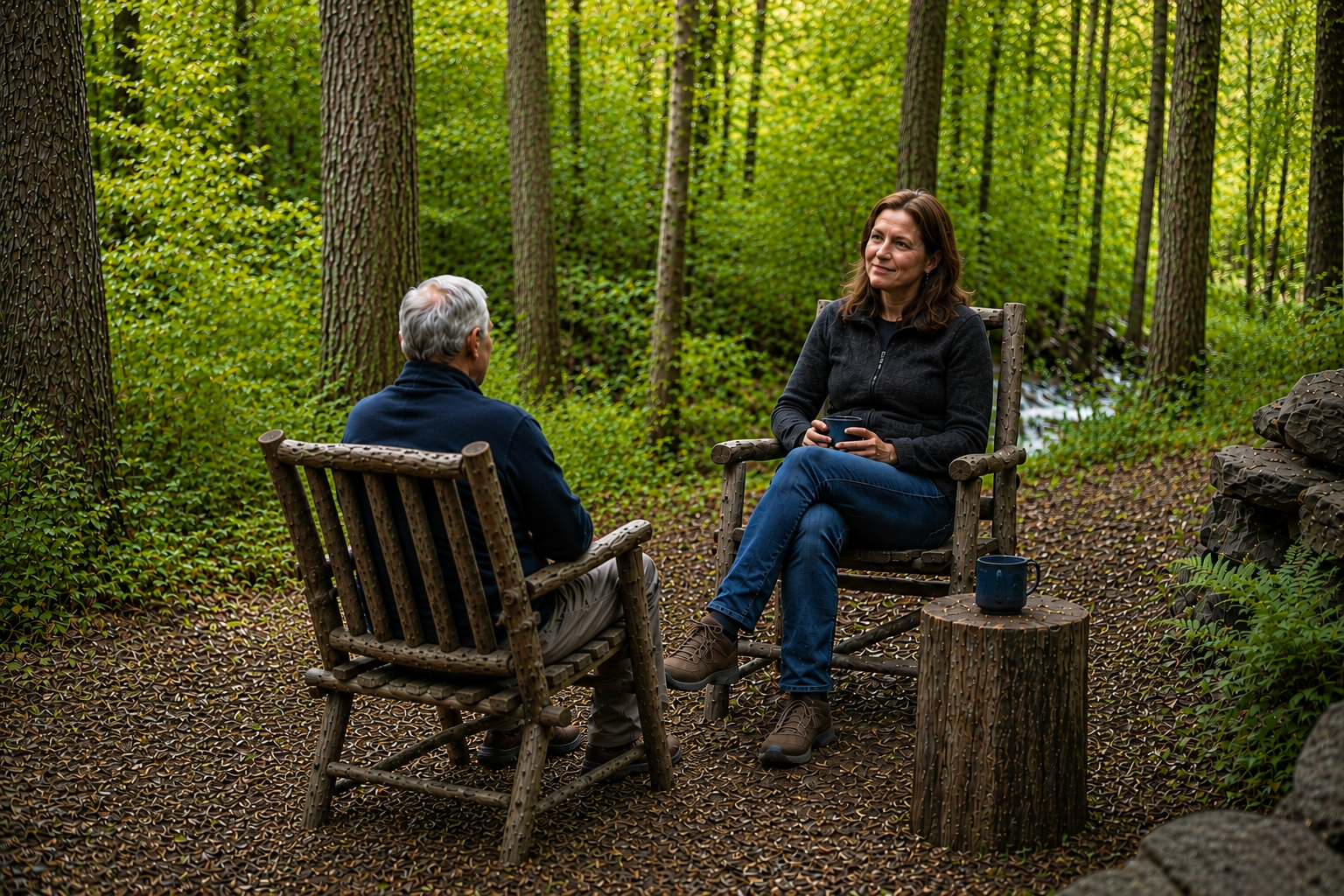
An ancient practice
Spiritual direction is one of the oldest practices in the Christian tradition — and one of the least understood. At its simplest, it is the practice of one person walking alongside another to pay attention to God together.
It isn’t about talking about God in the abstract, but noticing where He has actually been present and moving in the specific, ordinary, sometimes confusing landscape of your real life.
It isn’t therapy, though it can be deeply healing. It isn’t pastoral counseling, though Scripture and faith are woven throughout. It isn’t life coaching, mentorship, or accountability partnership — though it shares something with each of those. The spiritual director isn’t there to diagnose what’s wrong, fix what’s broken, or tell you what to do next. It’s something quieter and more spacious than any of that.
Spiritual direction typically involves two people meeting regularly — usually once a month, for about an hour. The conversation is unhurried. There’s no agenda to push through, no problem to solve before the hour is up. Instead, there’s an intentional slowing down: a settling into what’s actually been happening in your interior life, your prayer, your relationships, your work, your doubts, your longings.
The director listens — carefully, prayerfully, without rushing to respond. They listen not only to what you’re saying, but to what seems to be stirring underneath it. They might reflect something back to you, ask a gentle question, sit with you in silence, or simply name what they sense God may be doing in what you’ve just shared. The goal isn’t to fill the hour with insight. It’s to create enough stillness that the still, small voice has room to be heard.
“The goal isn’t to fill the hour with insight. It’s to create enough stillness that the still, small voice has room to be heard.”
Anything that touches your life with God is fair territory — which, in practice, means almost anything at all.
You might bring a passage of Scripture that has been following you around. A season of dryness in prayer that you can’t explain. A decision you’re holding and can’t quite discern. A wound from your past that keeps showing up in unexpected places. A moment of unexpected joy or beauty that felt like it meant something. A growing sense that God is inviting you somewhere new — and the fear that comes with that.
You don’t have to arrive with something figured out. You don’t have to have the right words. You can come with a question mark, a half-formed sense, or simply a willingness to pay attention. That’s enough.
A spiritual director is not a guru or an expert on your soul. They are a companion — someone who has done their own interior work, received their own spiritual direction, and been trained to hold sacred space for another person’s journey with God.
Their primary loyalty is not to their own insight or agenda, but to the movement of the Holy Spirit in your life. They trust that God is already at work in you — already speaking, already leading, already singing over you — and that their role is simply to help you hear what you might have otherwise rushed past.
A good spiritual director will celebrate with you, sit with you in the hard places, ask the question you were hoping no one would ask, and resist the urge to rescue you from the very places God may be doing His deepest work.
Spiritual direction is not reserved for monks, mystics, or people in religious life. It is for anyone who senses there is more to their life with God than they are currently experiencing — and who is willing to slow down long enough to find out what that might be.
If any of that resonates, you may be further along the path toward spiritual direction than you think.
Ready to slow down and listen together?
Begin the journey